Clip Art for Mixed Up Chameleon Clipart for Fox


Information provided for classroom use only; not for publication.
thevirtualvine.com 2005
*Prior Noesis: Find out what the students already know, or think they know, near chameleons by completing a nautical chart every bit a class: What Nosotros Know About Chameleons. Keep the chart so that it tin be revisited at the end of the week to check and encounter if what they knew was correct.
Facts
A chameleon is a cadger that is able to change it's skin color.
A chameleon can turn pink, chocolate-brown, blue, red, orangish, green, black and xanthous.
Unlike what is usually idea, chameleons do not alter colors to match their surroundings.
Chameleons change colors due to their physical condition, mood, temperature, light exposure,
and efforts to communicate and attract a mate.
Chameleons are naturally colored for their surrounding every bit a camouflage.
A chameleon is a reptile.
Chameleons are found in Africa, Asia, and Europe.
Chameleons have a poor sense of smell and are almost deafened.
They accept very skilful vision.
There are 100 different species of chameleons.
*Writing Assignment: Take the students do enquiry on chameleons if necessary and then complete the one of the following writing assignments.
Format ane
Format 2
*Scavenger Hunt: Created and shared by Alice Thomas
Scavenger Chase
*Comprehension: Listen to the story on tape. (you lot can record it yourself or purchase the book & cassette)
*Story Elements: After listening to the story and/or reading information technology, discuss the story elements: title, writer, setting, characters, main character, something that happened in the get-go of the story, middle, finish, problem, solution, was the author's intent to entertain, inform, or persuade the reader, what was the lesson learned?
I created story element pocketchart cards for this activeness. Impress the story element cards below on cardstock, laminate and cut out. Place them in your pocketchart one story element per row. The action can exist done in a couple of means. Equally you're discussing each chemical element, you tin can jot down the answers of the students. Later make answer cards from their answers by writing them on judgement strips (ane answer per story element). OR, you can have premade answer cards and equally a student supplies the reply, place the answer carte du jour in the pocketchart beside the story chemical element. (This is what I'll do)
The next mean solar day, after reading the story again, review the story elements. Then remove the answer cards and pass out to students making certain that everyone can read their answer card. (for lower level students, you tin can quietly read the answer card quickly with them as yous had them the card) And then go back to the pocketchart and read the story elements. As each element is read, the educatee with the correct answer menu should raise their hand and read their carte. If it's correct, they place the carte dorsum into the pocketchart abreast the correct story element.
The next day, you could take all the answer cards in the pocketchart, simply accept them placed mixed up and accept the students take turns putting the answer cards in the right place.
After the activity has been sufficiently reviewed, you lot can remove the answer cards and place them and the pocketchart with the story elements in a work station or center for the students to consummate individually or in pairs.
printable story element cards
* Comprehension: Accept students read or listen to the first paragraph of the story. Accept them create their own booklet for the paragraph. Write one judgement on each page and illustrate it. For example:
ane) A pocket-sized dark-green chameleon sat on a green leaf.
2) He moved to a brown tree and turned brown.
iii) He got on a red flower and turned red.
four) When he got on the sand he turned yellow. You could inappreciably see it.
*Shared Reading & Concepts About Print: W rite the sentences from each folio to make a pocketchart activity so that they can be read together. The teacher will bespeak at each word as it's being read. So the students can match pictures to each sentence. The picture show cards are made by using clipart, press onto cardstock and laminating.
I've converted the printables for this to PDF format,
so you'll need Adobe Acrobat Reader to open the file.
The Mixed-Upward Chameleon Pocketchart Pictures
I wish I could be big and white like a polar bear. (white polar bear)
I wish I could be handsome similar a flamingo. (pink flamingo)
I wish I could be smart like a play a joke on. (red play a trick on)
I wish I could swim like a fish. (orangish fish)
I wish I could run similar a deer. (brown deer)
I wish I could see things far away like a giraffe. (yellow giraffe)
I wish I could hide in a vanquish similar a turtle. (green turtle)
I wish I could be strong like an elephant. (blue elephant)
I wish I could exist funny similar a seal. (purple seal)
I wish I could be like people. (people)
I wish I could be myself. (chameleon)

I too fabricated an extra set of the text (on yellowish judgement strips) and cut them autonomously. (in bag) Students tin use to match the text.
*Sequencing: They can use the aforementioned pictures/sentences higher up to exercise sequencing in the pocketchart. They can sequence the pictures and/or sequence the sentences.
*Discussion Order: Brand a second set of sentence strips using another color and cut the words apart. Students will build the text next to the sentences in the pocketchart using the word cards. (in a wide pocketchart .. if using a standard pocketchart you lot'll probably accept to provide a model of the sentences printed onto cardstock) Word cards will exist cut close to the word so that accent can be placed on the educatee creating �meatball� spaces between the give-and-take. Lower ability students can lucifer the words to the text by placing the word carte du jour OVER the matching give-and-take in the text (judgement strips that aren't cut apart). More advanced students tin create the sentences without a model. Yous may want to separate each sentence into a ziplock bag to brand it a little easier.
*Comprehension: Pupil can choose one sentence from the pocketchart activeness above to re-create on his paper and illustrate.
*Song Nautical chart: This is posterboard size and the chameleons are clipart from the 'internet. I added a strip of grass border across the lesser and some flying insect stickers earlier laminating. Do you just hate that laminating glare on pictures? :( Simply the nautical chart turned out beautiful and the kids like it and the song.

*Color Words Friction match: Use a chameleon illustration and copy onto different colors of cardstock. Create some colour words cards so that they can friction match them to the correct color chameleon.
When I actually started creating this I changed up my idea. Ballad, at The Learning Tree, shared ane of her ideas with me using letter of the alphabet tiles and I adapted it (of course, we both do that ;) ) and came upwards with this activeness. In this activity the pupil has to friction match the correct color chameleon to the one on the carte AND and then build the color word using the letter tiles. They fit into the blank boxes. Y'all tin buy yellow letter tiles from the instructor catalogs or y'all can purchase white alphabetic character tiles from Wal-Mart for effectually $iv a gear up. I have both. I prefer the ones from Wal-Mart because they are thinner and have up less room in my letter case (a plastic nuts and bolts storage example besides from Wal-Mart). The chameleon pattern I had in my files and information technology's originally from The Mailbox online. (Cheers Carol for sharing your ideas and your template! ;) )

When I first came up with this idea, well .. after the start, first :), I was going to make the mats in a higher place but put "light-green" on green, and "cherry" on red to prove the way the chameleon's skin changes to camouflage himself. And so after I got into it, I realized that the colored mats would give abroad the color give-and-take, so I changed the idea. You could employ the "camouflaged" version with preschoolers who are working on learning their colors and leave off building the give-and-take if you liked.
*Story Innovation: Students tin write their ain story using the aforementioned format: I wish I could be .... or they tin can work together to create a classbook. Each student would complete the judgement frame and illustrate their ain page, and then all the pages would exist compiled together to brand a book. I suggest typing up each pupil'south judgement on page for them to illustrate rather than relying on them to impress information technology correctly. I feel like if you're going to "publish" something like this that information technology should be in an hands read format.
*Graphing: Have students decide what they'd rather exist and graph the results as a grade (polar behave, flamingo, play tricks, fish, deer, giraffe, turtle, elephant, seal, person, chameleon) Yous tin can create a class pictograph by having each student write their proper noun on a boy or girl die-cut. Each educatee would identify their dice cut in the correct spot on the graph. (Use bulletin board paper or a white plastic shower drape to create the graph and the printables from above for the column icons) Students tin use the class graph to transfer to their own graph and create a bar graph.
printable student graph and graph questions (below)
*Interpreting a Graph: Answer questions on response sheet using graph. For example:
How many people would rather be a turtle?
How many people would rather exist a giraffe?
How many people in all chose to be a giraffe or a turtle?
How many people are in the class?
Which 1 was chosen more?
Which ane was called less?
Were any the same?
*Have students depict what they'd rather be (from the choices in a higher place) and write why they chose that answer.
* Rewrite the story having the chameleon visit a circus, a school, a infirmary, etc. instead of a zoo.
*Alphabet Match: Cut a chameleon graphic(south) into half. Program head side with a capital letter & tail side with a lowercase letter. Tin can utilize different graphics or dissimilar colors.
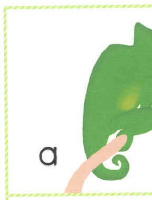

Chameleon ABC Matching Cards
*Showtime Sounds Match: Chameleon graphic with lowercase letter of the alphabet & match to picture that begins with aforementioned sound.
printable showtime sounds matching cards
*Building Words: Make words from the story using big chameleon graphic and the word written in tiled messages. Students build the word underneath information technology using plastic letter tiles. If you use a chameleon illustration instead of a graphic, you lot can place the word on the chameleon. For animal words like turtle, pull a fast one on, giraffe, etc., you tin use graphics of the animal with the give-and-take instead of the chameleon.
*Ending sounds: Use a graphic for each animal in story and write the word leaving off the concluding HEARD ending sounding. Create ending sound cards. For words like giraffe and turtle, you tin can use �iron� or "le" with a slash through the e indicating that the e is non heard (silent).
*Starting time or Catastrophe sounds: Use animal graphics from story and place on a judgement strip vertically as information technology is in the story. Program wooden clothespins with the offset or catastrophe sound for each brute. Have the student clip the correct pin with the outset or ending sound to each animal film. OR, you lot could do both ... beginning sound clips on the left side of the strip and ending audio clips on the right side of the prune. Be sure to place your clips on the strip before programming them to insure that the letters are programmed correctly. If you don't, you're liable to take letters upside downwards.
Sentence strip pictures printable
*these are sized to fit on a sentence strip vertically*
*Vocabulary Words: You tin can also use the activity above, simply instead of programming the clothespins with first sounds, you lot could program them with the animal names.
*Patterns: If you lot print out multiple copies on the animal cards to a higher place, you tin employ them to practice patterning in the pocketchart. Ex. giraffe, elephant, elephant
*Art: Give each student beast parts or let them create their ain. They volition glue them together to create a new kind of animal. They will need to proper name their animal and write one sentence virtually it. They tin can employ the sentence frame: I wish I were a ______.
*Compare & Contrast: After reading The Mixed-Upward Chameleon several times, read Leo Leonni'due south A Color of His Own several times. Then use a Venn diagram to compare and contrast the ii stories.
*Culminating Activeness: Lookout man the video of The Mixed-Up Chameleon. It's on the video with The Very Hungry Caterpillar
Related Books:
A Color of His Own - Leo Lionni
Resources:
Lizards - MM2096 Snips and Snails
A Color of His Own - The Mailbox Aug/Sept 2002
Colour Fourth dimension - A - Z Language Games PreK - K MM2047
Links:
The Chameleon emergent reader
http://www.teachersbookbag.com/miscbookcompanions.html
Vocabulary Planning Sheet
http://www.nevadareading.org/resourcecenter/vocabulary.attachment/313848/Harcourt_Grade_2_Theme_1_
Week_1_Mixed_Up_Chameleon.pdf
Literacy Bag for The Mixed-Up Chameleon
https://www.childcrafteducation.com/cc/Article_inst_2.asp?UID=2005040208375473
Incorporating Engineering science
http://www.edu.pe.ca/tracadiecross/EricCarle.htm
Linguistic communication Experience Lesson (curlicue downwards)
http://www.valdosta.edu/~gcharrel/kids.html
Mixed-Up Chameleon
http://world wide web.hitchams.suffolk.sch.britain/ict_art/chameleon/
http://www.hitchams.suffolk.sch.uk/ict_art/chameleon/the_process.htm
The Mixed-Upward Chameleon resource
http://www.kiddyhouse.com/Teachers/Literature/mxchameleon.html
Bulletin Board - The Mixed-Up Chameleon
http://www.eric-carle.com/bb-chameleon.html
Mixed-Upwardly Chameleon - Grade 2 lesson plan
http://www.rcs.k12.va.us/art/lessons/ferguson03.htm
Scientific discipline-Literature Links - The Mixed-Up Chameleon
http://www.scilitlinks.org/chameleon.htm
The Mixed-Up Chameleon
http://www.kiddyhouse.com/Teachers/Literature/mxchamchwords.html
Chameleon Observation
http://www.canteach.ca/simple/life21.html
Chameleons Science Lesson Plans (3rd)
http://www.lessonplanspage.com/ScienceLAChameleons3.html
Visiting Chameleon (Gr ii)
http://www5.cet.edu/designs/bstupak/print.html
Reptiles
http://www.schooltrain.info/science/animals/groups/reptiles2.htm
All Mixed Up
http://www.glc.k12.ga.us/BuilderV03/LPTools/LPShared/lpdisplay.asp?LPID=15432
Who Am I?
http://www.glc.k12.ga.united states of america/BuilderV03/LPTools/LPShared/lpdisplay.asp?LPID=12464
Children's Art Showroom - The Mixed-Up Chameleon
http://www.mazzamuseum.org/didactics/student/exhibit.html
Building Upwards Cocky-Esteem Through The Mixed-Up Chameleon
http://www.tamagawa.ac.jp/teachers/edu/ohtani/handouts/Sample.htm
LizardHouse
http://www.lizardhouse.com/
The Mixed-Up Chameleon (story prop printables)
http://kizclub.com/storypatterns/chameleon(C).pdf
http://kizclub.com/storypatterns/chameleon.pdf
Source: https://www.thevirtualvine.com/themixedupchameleon.html
0 Response to "Clip Art for Mixed Up Chameleon Clipart for Fox"
Post a Comment