What Will Happen to the Crust as a Glacier Grows?
About the demonstration
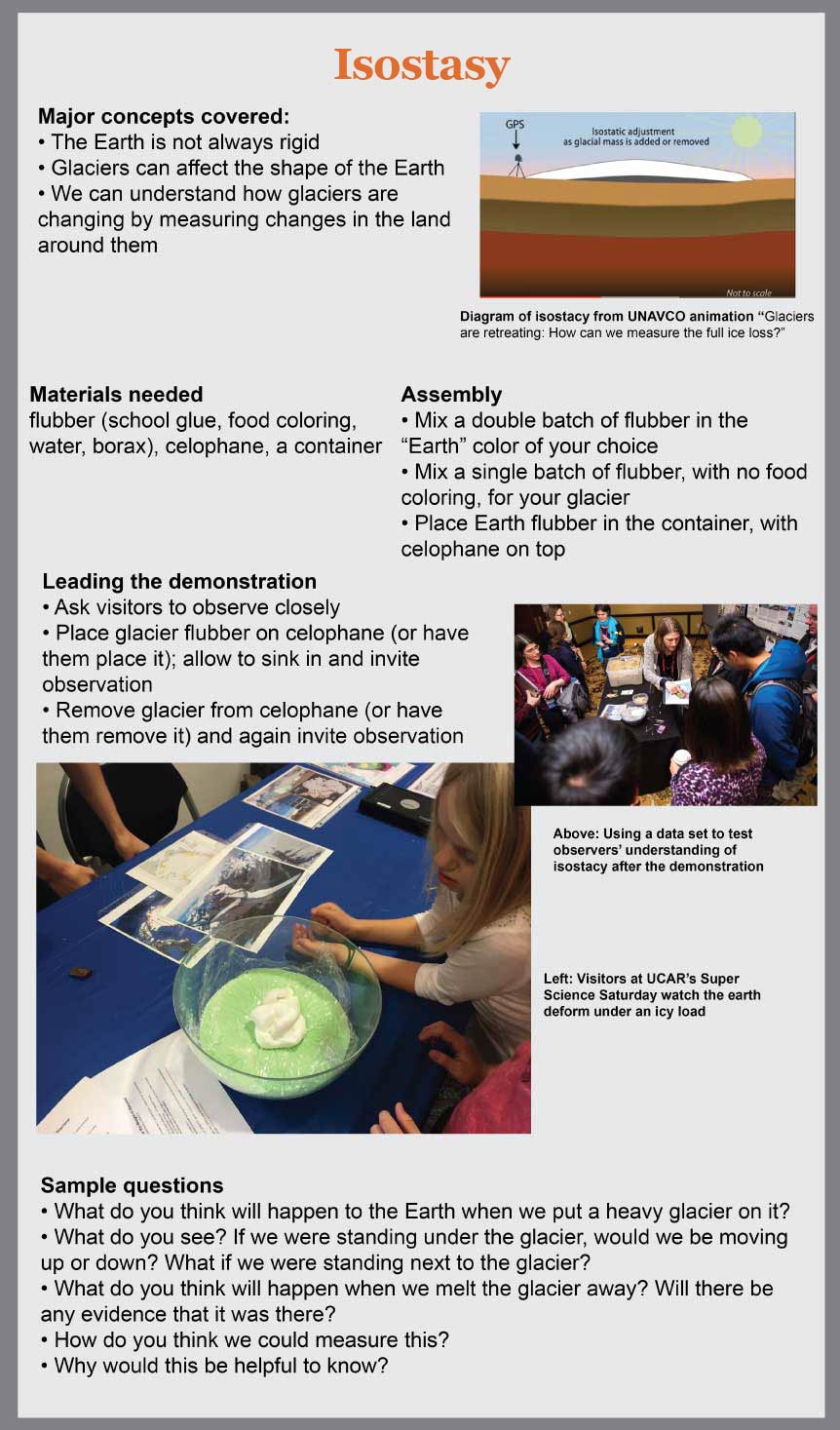
Using 2 sets of flubber, ane representing the Globe and one representing a glacier, demonstrate how the crust sinks and rebounds to the weight of a glacier, and how this motion tin can exist measured using GPS.
Flubber is a rubbery elastic substance, a non-Newtonian elasco-plastic fluid, that flows under gravity, but breaks when under high stress. Flubber is useful for demonstrating a wide range of World and glacier processes.
Points to call up
- Flubber responds to ho-hum changes of stress (such as adding or removing weight) in an elastic fashion like to the crust and mantle.
- Flubber is neither a glacier or rock.
- Stone rebounds less chop-chop than flubber.
Sit-in Length
30 minutes to make the flubber
5 – xx minutes to demonstrate
Major concepts
- The crust is not ever rigid.
- Glaciers can bear on the shape of the Earth.
- As a glacier grows, the weight of the glacier depresses the crust downwards. As a glacier shrinks, the crust rebounds upwards in the surface area effectually the glacier.
- Nosotros tin can use GPS to measure how glaciers are changing by measuring meridian changes over fourth dimension of the state around them.
Supplies
- Flubber (school glue, borax, nutrient coloring and water, * see the Supplementary Materials tab for more details)
- Clear container (large bowl)
- Cellophane
- Air-tight storage numberless (to hold extra flubber)
- Gumdrops and toothpicks (to brand GPS models)
Instructions for assembly
- Mix a double batch of flubber in the "Earth" color of your selection.
- Mix a single batch of flubber, with no food coloring, for your glacier.
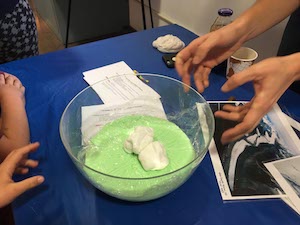
- Place Earth flubber in the container, with cellophane on top. Allow it settle.
- Have the glacier flubber ready to place on the Earth.
Leading the demonstration
- Describe the parts of the model:
- The flubber in the bowl is the Earth's asthenosphere (the lower pall, more rubberband)
- The cellophane is the lithosphere (crust + upper portion of the mantle)
- The white flubber is the glacier
- Ask visitors to find the "land" flubber closely as you lot place the glacier flubber on cellophane (or take them place it); invite observations by the visitors while the glacier sinks in.
- Quickly remove glacier from cellophane (or have them remove it) and once again invite observation equally the lower Globe flubber moves.
- Repeat placing and removing the glacier multiple times while visitors view from the side and focus on different areas of the Earth flubber.
- Optional: Have visitors identify GPS models on the flubber at various places and measure out the deflection of the state near the glacier and at the edge of the bowl.
Sample questions to consider
- What do you think will happen to the Globe's crust when we put a heavy glacier on it?
- What do you come across? If we were standing under the glacier, would we exist moving up or down? What if we were standing next to the glacier? ... farther abroad from the glacier? ... well-nigh the edge of the bowl?
- What practice yous recall volition happen when we cook the glacier abroad? Will there be any evidence that it was there?
- How practise y'all think nosotros could measure out this?
- Why would this be helpful to know how much ice has melted?
Make the Flubber
Note that you'll need one batch for the glacier and a double batch for the Earth.
Ingredients for one batch:
- 2 mixing bowls
- Measuring loving cup and spoons
- 1 cup white gum
- 1 1/two teaspoon borax
- Food coloring
- Warm water
Instructions for making flubber
- In the commencement mixing bowl, combine iii/4 cup warm water and i cup glue (and nutrient coloring if needed). Stir until well mixed.
- In the 2nd bowl, combine 2/3 loving cup warm h2o and 1 1/two teaspoon borax.
- Combine the contents of the two mixing bowls (whip the materials together), and stir until a gooey blob forms. Flubber volition be viscid for a moment or two. Let the backlog liquid drip off.
More than ideas!
-
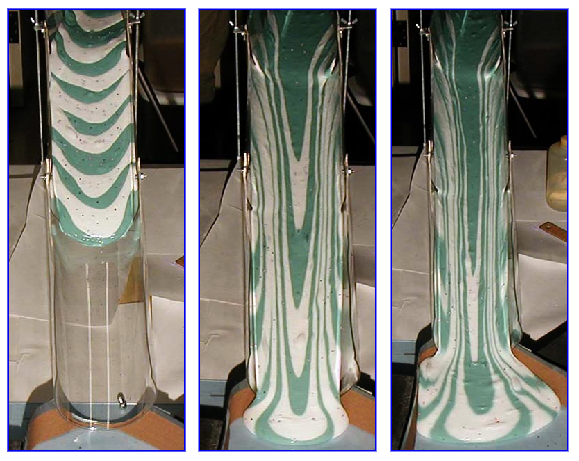
Employ flubber to demonstrate how glaciers move and flow! Place flubber on a 3-D model of a mountain or create a U-shaped valley made from clear plexiglass or tubing. By using a clear plastic, you can see the superlative and bottom motions of the glacier.
- Evidence a map with data plotted to test observers' understanding of isostasy after the sit-in.
Globe-focused modules for undergraduate classroom and field courses
Water ice mass and bounding main level changes
Function of the GETSI collection.
In this 2-3 week module, students interpret geodetic information from Greenland to assess spatial patterns and magnitudes of ice mass alter and consider mechanisms and timescales for ice mass loss. They as well investigate the human relationship between ice mass change and global and regional sea level, with an emphasis on the ongoing and future implications of sea level modify on civilization. Materials for student reading and preparation exercises, in-class discussions, lab exercises, modest group activities, gallery walks, and wall walks are provided, equally well as educational activity tips and suggestions for modifications for a variety of course formats.
- GPS Blitheness - Glaciers are retreating: How can we measure the total ice loss?
Source: https://www.unavco.org/education/outreach/demonstrations/science-with-flubber-glaciers/science-with-flubber-glaciers.html
0 Response to "What Will Happen to the Crust as a Glacier Grows?"
Post a Comment